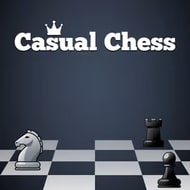
Casual Chess is a turn-based strategy game designed to make classic chess accessible while still rewarding thoughtful decision-making. Players can focus on planning moves, understanding piece interactions, and improving tactical awareness without pressure from complex interfaces. The gameplay centers on clarity, steady progression, and learning through repeated matches.
Core Rules and Board Interaction
The foundation of Casual Chess follows traditional chess rules, with each piece retaining its familiar movement and role. Players alternate turns, aiming to control the board, protect key pieces, and create opportunities for attack. The game emphasizes reading the board state and anticipating opponent responses rather than relying on speed.
- Standard chess piece movement and capture rules
- Turn-based structure encouraging careful planning
- Focus on board control and positioning
- Clear visual layout for easy decision-making
Learning Curve and Player Support
Casual Chess is structured to support players at different skill levels. Beginners can learn through repetition and observation, while experienced players refine strategies and test new openings. The pace allows players to analyze outcomes and adjust tactics without feeling rushed.
- Suitable for beginners and experienced players
- Opportunities to learn from repeated matches
- Emphasis on understanding cause and effect
- Steady improvement through practice
Strategic Depth and Common Tactics
Although the presentation is simple, the strategic depth remains intact. Players must balance offense and defense, manage trades, and plan several moves ahead. Common tactics such as forks, pins, and discovered attacks play an important role in gaining advantage.
- Planning multiple moves in advance
- Using classic tactics to gain material
- Balancing aggressive and defensive play
- Recognizing threats before they develop
Match Flow and Decision-Making
Each match progresses through opening, middle, and endgame phases. Players decide when to develop pieces, exchange material, or push for a decisive attack. Understanding when to simplify the board or maintain tension is a key part of long-term success.
- Opening development and early positioning
- Middle-game planning and tactical execution
- Endgame focus on precision and efficiency
- Decision-making based on board evaluation
Player Questions and Practical Tips
Players often ask whether memorizing openings is required. In Casual Chess, understanding general principles such as piece activity, king safety, and pawn structure is usually more effective. Focusing on fundamentals helps players respond confidently to unfamiliar positions.
- Prioritizing fundamentals over memorization
- Developing pieces before attacking
- Keeping the king protected
- Learning from both wins and losses
Casual Chess delivers a focused strategic experience where thoughtful planning and steady improvement define success. By maintaining familiar rules and a clear presentation, the game allows players to concentrate on decision-making, develop long-term skills, and enjoy the depth of classic chess at a comfortable pace.