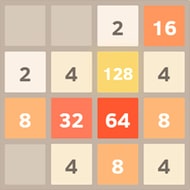
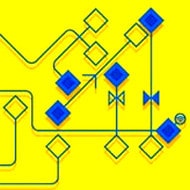
Rhomb is a carefully designed puzzle experience built around precision movement and layered thinking, where every action reshapes the entire board. Players are invited to explore compact geometric arenas filled with diamond-shaped pieces, tight corridors, and logic-based obstacles. Each stage of Rhomb challenges the ability to predict outcomes, adapt strategies, and refine decisions through observation and experimentation.
Grid Logic and Chain Reactions
In Rhomb, the entire challenge revolves around how movement propagates across the grid. When a direction is chosen, all pieces respond simultaneously, sliding until they reach a boundary or another tile. This creates unpredictable chain reactions that must be anticipated before any action is taken. The Rhomb game rewards foresight, as even a single incorrect shift can completely reshape the puzzle state.
As levels progress, layouts become more intricate, introducing narrow passages, multi-layered barriers, and synchronized tile dependencies. Players quickly learn that success depends not on speed but on structured thinking. The Rhomb game often requires multiple attempts, not as punishment, but as a way to understand deeper interactions within each puzzle.
Progression Through Layered Challenges
The structure of Rhomb is built around gradual complexity, where new ideas are introduced step by step. Early stages focus on simple navigation, while later stages combine multiple systems into dense puzzle arrangements. The Rhomb game ensures that each new mechanic is first experienced in isolation before being merged with others.
- Directional sliding systems that affect all active tiles at once
- Blocking structures that redirect or halt movement paths
- Target zones requiring precise alignment of multiple pieces
- Multi-stage layouts where one solution unfolds in several steps
This structured progression allows players to build confidence while continuously adapting to new types of reasoning. Rhomb encourages experimentation, making every failed attempt a source of useful insight rather than frustration.
Observation, Planning, and Adaptation
One of the most important skills in Rhomb is the ability to observe the entire board state before acting. Many puzzles are designed so that early moves determine all future possibilities. The Rhomb game encourages players to pause, analyze, and mentally simulate outcomes before committing to a direction.
To improve performance in difficult stages, players often rely on a few key approaches:
- Break the puzzle into smaller zones and solve them step by step.
- Track how each movement influences multiple tiles simultaneously.
- Reevaluate assumptions after every failed attempt instead of repeating the same sequence.
- Look for hidden alignment patterns that reveal optimal move chains.
Depth, Flow, and Puzzle Satisfaction
Rhomb stands out because it combines simplicity of control with deep strategic potential. There are no unnecessary distractions, allowing full focus on spatial reasoning and logical deduction. The Rhomb game creates a calm yet mentally engaging environment where each solved level feels like unlocking a carefully constructed mechanism.
As players advance, puzzles become more interconnected, requiring long-term planning and flexible thinking. The satisfaction comes not only from completing a level but from understanding why a solution works. This makes Rhomb highly replayable, as players often return to refine their approach or discover more efficient solutions within the same layouts.